I decided to write about my lived experience as a bisexual woman, highlighting some of the bi-phobic attitudes that I have encountered over the years. This may not be an easy read, it was certainly not easy to write, but I hope it may be relatable to others and insightful for would-bi allies.
Definitions
“Bisexual” or “bi” means we experience both same gender attraction and different gender attraction.
“Pansexual” or “pan” means we are attracted to individuals, and their gender does not come into it.
Some bi or pan people may also identify as “queer”, which is a less clearly defined, more flexible term.
Why?
You may wonder, “why talk about your sexuality?” or “how is this professional / appropriate / relevant?” Those are questions I have often seen asked of LGBTQIA+ lived experience story tellers.
Let me be clear – this is not a blog about sex. It is in no way inappropriate. This is about my experiences as a member of a sexual orientation minority group, which is part of my authentic identity, the whole self which I wish to be free to embrace, unmasked.
Sexual orientation (sexuality) is a protected characteristic under the Equality Act 2010, and we should be able to talk freely about this without fear of discrimination. I am autistic as well, another protected characteristic – an intersection which is very common, and particularly challenging in some ways.
Not everybody with a protected characteristic feels safe and comfortable to ‘step up’ as a role model in the workplace or in their community, but positive visible role models and story telling can help foster a culture of inclusion and belonging, which matters!
Bisexuality is far more common than people realise. You all have colleagues, friends, and possibly family members, who are bi. However, they may not be visible or ‘out’ about their sexuality – especially if they are in a ‘straight-passing relationship, and especially if they are from a background where their true sexuality would not be accepted by some and ‘straight’ is the societal expectation.
Coming out story
I was sixteen when I first concluded that I was bi. I was open about this with my best friend, but not with my family or wider social circle. However, the truth came out during a sixth form residential trip over a boozy game of truth or dare. I was naïve, a socially awkward undiagnosed bullied autistic teenager, desperate for validation and acceptance. Bisexuality seemed so normal to me, I had hoped that among the reactions from other kids would be some nonchalant “so what, me too” or something. Instead, all I got was a barrage of intrusively probing personal questions. When it dawned on me that I had said too much, to people I had no reason to trust, I got anxious and had a meltdown.
In the days following the school trip, another friend (devoutly religious) was hostile towards me, because I had gone camping with her the previous year without telling her about my sexuality. I was not into her in that way anyway, and I was not ‘out’ at the time.
That was in the mid-90s. I believe, I hope, that teenagers today are more open-minded and accepting.
Things got easier at university, in this respect anyway, because at least there I was able to join an LGBT+ society and make some like-minded friends.
Bi-phobia
My coming out story mentioned two bi-phobic microaggressions, and here are some more of the bi-phobic attitudes and microaggressions that I have personally encountered:
Men (including some long-term boyfriends) who assume I cannot be in a monogamous relationship for long, and that I will inevitably cheat on them or leave them for a woman. We do not have to ‘pick a side’, we fall in love with a person. We are just as capable of monogamy as anybody else, not that there is anything wrong with alternative relationship structures nor with playing the field.
Predatory couples looking for a third wheel, or ‘unicorn’ (I was only sixteen when I was first approached in that manner, and vulnerable to abuse as an undiagnosed autistic and people-pleaser).
The jokes. Okay, so I like a giggle and personally I would chuckle if somebody said, “well I suppose it doubles your chances of a date on a Saturday night”. Some of the bi jokes are offensive, and some bisexual people are more easily upset about the jokes than others. Sexuality is a sensitive subject to many, and we have a right to our dignity and not to be the subject of bullying jokes and banter. If in doubt about how your joke may be received, then please resist making it.
People who think bisexuals are not a valid part of the LGBTQIA+ spectrum, and that we should not be at Pride, especially if we are in a straight-passing relationship. Firstly, the B stands for Bisexual, we are still a minority group. Secondly, please do not assume our gender, nor the genders of our partners.
Women who assume I fancy them, just because I am friendly towards them. This is a particular issue for autistic bisexuals, as we may struggle with the nuances of communication, particularly non-verbal communication such as body language, when communicating with our neurotypical peers. I can be bi and still not into you. I am pretty choosy! And also happily married.
Stepping up
That last issue caused me real problems at work, many years ago now, but as a result for several years I stopped being open about my sexuality and even stopped disclosing it on the HR system (and I worked in HR…).
But that all changed when I read an article by Stonewall about why LGBTQIA+ role models are important, with their top ten tips about how to be a positive visible role model. That was just the gentle push I needed to put my difficult past behind me and ‘step up’, especially after losing my son Iggy in 2019 (he was also autistic and LGBT, and had few positive visible role models at his school).
For as long as I remain comfortable disclosing my authentic identity, I will carry on talking about it and writing about it to help others. I hope to inspire others to do likewise. Thanks for reading.
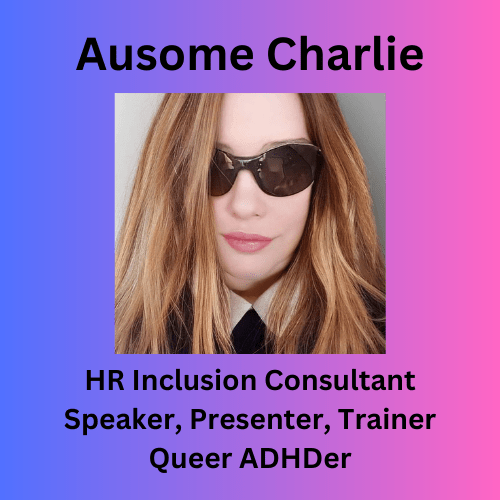
 Ausome Charlie
One thought on “Insight into Bisexuality by Charlie”