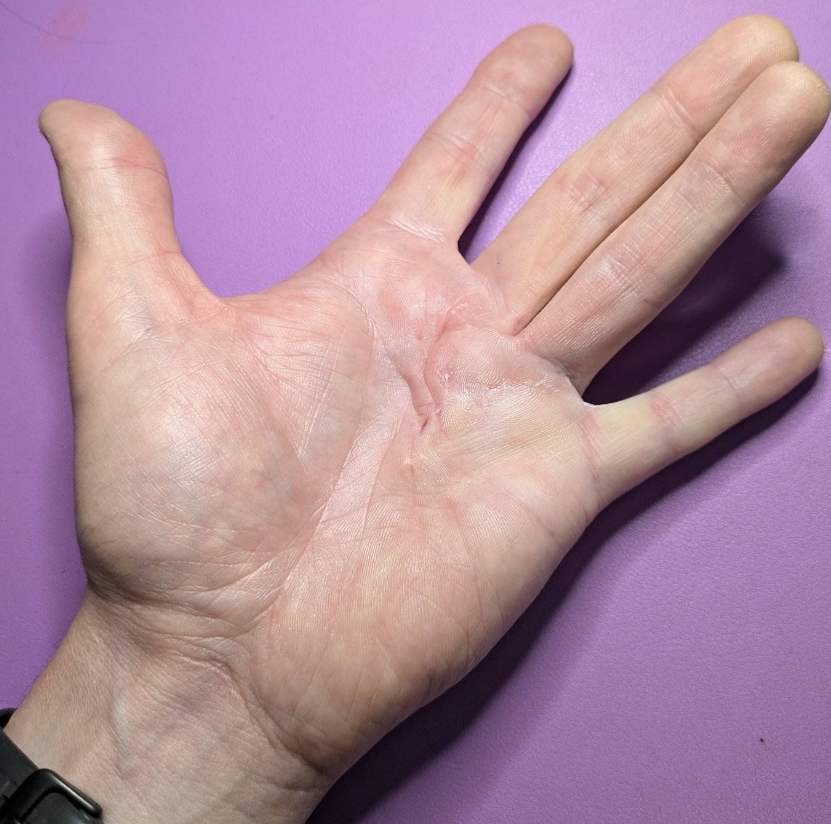
Have you heard of Dupuytrens Disease or Contracture?
https://dupuytrens-society.org.uk/information/dupuytrens-disease/
Dupuytrens is more common in type 1 diabetics, and type 1 diabetes is far more common in autistic people. If you have type 1 diabetes, it is more likely you are autistic.
We autistic people seem to me more likely to go around oblivious that there is something physically wrong with us, struggling with conditions like Dupuytrens, or frozen shoulder, or rheumatoid arthritis, or long Covid, without even knowing, assuming the symptoms are just part of getting older.
If you are autistic, or you have autism running in your family, it may be a good idea to read up about some of the correlating medical conditions. I am not trying to turn you all into hypochondriacs, but if you have a physical condition which is treatable then it is worth knowing about it.
I am posting about this condition because my dad and my husband Si Hart both have Dupuytrens, and the diagnosis and corrective surgery has improved their quality of life (they both play guitar). Unfortunately, Si needs to have his surgery again, this Wednesday, although apparently he plans to rest from guitar playing for longer this time (but knowing Si, who is very impatient at recovery, I will believe that when I see it).
Si has also needed four surgeries for diabetic frozen shoulder (he left that painful condition untreated for years thinking that it was tension or poor posture and could be fixed with massage).
Physical conditions which are more common in autism families include:
– Auto-immune diseases, such as Fibromyalgia, Hashimoto’s Thyroiditis, Type 1 Diabetes, Coeliac Disease, Rheumatoid Arthritis, Lupus and Multiple Sclerosis (MS).
– Epilepsy and seizure disorders
– Atopic conditions such as asthma, eczema and hay fever
– Gastro-intestinal problems including IBS and Inflammatory Bowel Disease
– Connective tissue disorders such as hypermobility, Ehlers-Danlos Syndrome (EDS) and Marfan Syndrome
Side note: I am angry that when I had Iggy assessed for Marfan they did not assess him for hypermobile EDS, as I am now convinced he had hEDS and that this was one of the things that made his life harder!
I have written this post in my own words, and I am no medical expert (not beyond A-Level Biology), but the correlation is anecdotally observable to me.
Thanks to my friend Neurodivergent Exec for encouraging me to post about this when I mentioned it to you.
Thanks to Melanie Costas ~ Pink Haired Warrior 💖 for inspiring me to write about the anecdotally observable phenomenon that neurodivergent people are more likely to go around oblivious to how physically unwell or injured we are. This could be to do with poor interoception, or maybe we are just accustomed to struggling through life?
To learn more about physical health conditions that correlate with autism, please follow Jane Green MBE FCCT and SEDSConnective.
 Ausome Charlie