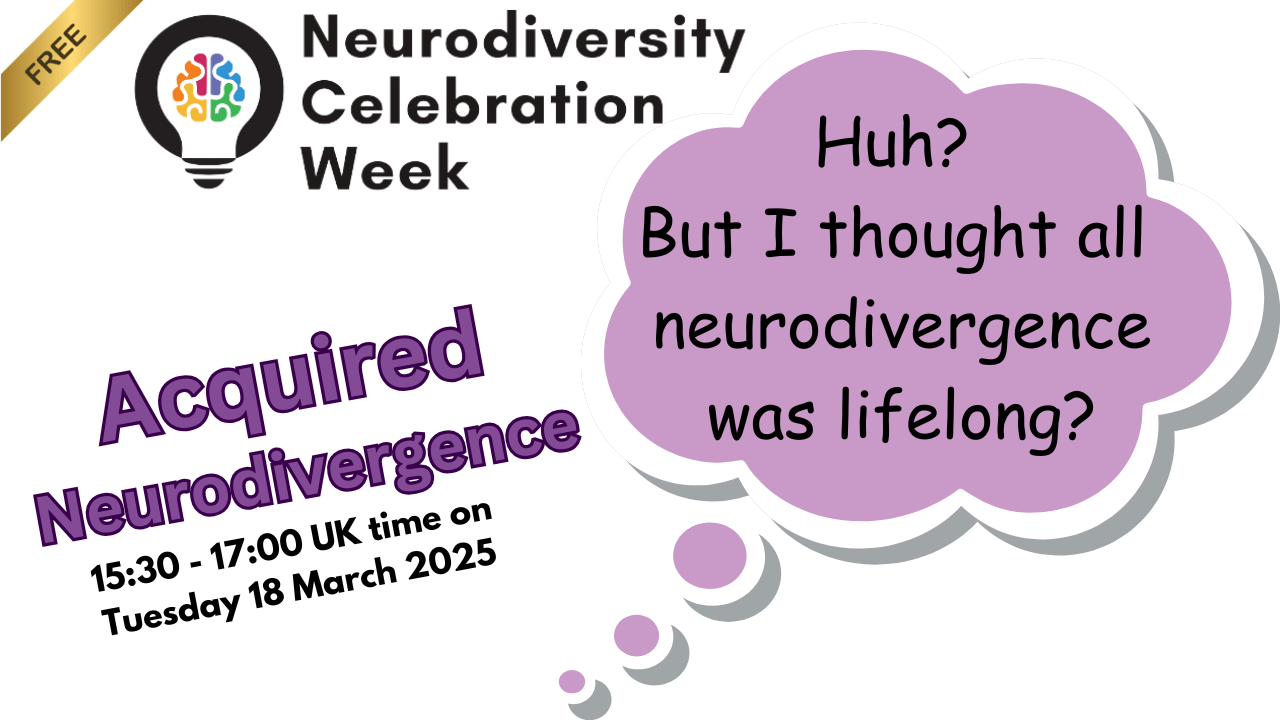
I received this great question yesterday by email, and I’m sharing my response here in case it helps my readers. This is also covered in my Introduction to Neurodiversity talks.
Question: I will be attending some events during neurodiversity week. I have seen that there will be a discussion chaired by Charlie Hart entitled ‘Neurodiversity and Mental Health: Acquired Neurodivergence‘. I would like to ask what you mean by acquired neurodivergence? The phrasing indicates that neurodivergent conditions are not lifelong, but can be ‘acquired‘ throughout life, which goes against current recognised peer-reviewed research. I am aware that there may another definition of this and that I am making assumptions based on the literal meanings of the words acquired and neurodivergence.
Charlie’s Answer: When I say ‘neurodivergence‘ I am applying the original definition of the word. Kassiane Asasumasu coined the terms ‘neurodivergent‘ and ‘neurodivergence‘ circa 2000. According to Kassiane, these terms refer to people ‘whose neurocognitive functioning diverges from dominant societal norms‘.
Kassiane intended for these terms to apply to a broad variety of people, not just those with lifelong neurodevelopmental differences such as autism, ADHD, and dyslexia. She emphasised that ‘neurodivergent‘ and ‘neurodivergence‘ should not be used to exclude people, but rather to include them, stating: ‘Neurodivergent explicitly and loudly includes mental illness (or psychiatric disability for those who prefer that term)‘.
For Neurodiversity Celebration Week 2025, I will introduce a panel of new voices to NCW, and we will share our lived experience of acquired neurodivergence. The point of this event is to shine a light on neuro-differences which fall within the neurodivergent umbrella, but which are not lifelong neurodevelopmental conditions.
Sign up here: https://www.neurodiversityweek.com/event/neurodiversity-mental-health-acquired-neurodivergence
As it happens, my whole panel are autistic and/or ADHD, but in addition to those lifelong neurodevelopmental differences we have acquired neuro-differences as well, and between us we represent complex PTSD, schizophrenia, OCD, borderline personality disorder, dissociative identity disorder, PDA and more. These neuro-differences are rarely spoken about within the neurodiversity context, but, yes, they are absolutely forms of neurodivergence in accordance with Kassiane’s definition and intention, and acquired.
The phrase ‘neurodivergent condition‘ can be unhelpful, because it juxtaposes the word ‘neurodivergent‘ which is a term from the neurodiversity paradigm, and a socio-political term, with the word ‘condition‘ which is a term from the pathology paradigm and the medical model of disability and . You may notice that I describe autism, ADHD, dyslexia etc as ‘neurodevelopmental differences‘ rather than ‘neurodivergent conditions‘ and this is why: I try to avoid muddling my paradigms (although medical terminology can be helpful when seeking support and reasonable adjustments).
I am not suggesting that autism, ADHD, dyslexia etc are not lifelong, nor that they can be acquired. My intention is to increase understanding and acceptance of acquired neuro-differences which are rarely talked about in the context of neurodiversity acceptance and inclusion, and to introduce some awesome speakers who have not previously been platformed by Neurodiversity Celebration Week.
 Ausome Charlie