My Autistic Diagnosis and Livid Experience
How and why was I diagnosed, and where did this lead me?
I am often asked how and why I was diagnosed autistic, what is even the point later in life? Well, I was diagnosed aged 42 after struggling for decades and not understanding why.
In 2018, I took my eldest child Iggy, who was 14 at the time, to see a psychologist about his extreme anxiety attacks. She listened and observed, then concluded that what Iggy was describing was something more extreme – autistic meltdowns.
Yes, anxiety was an issue, but her impression was the underlying cause was undiagnosed ‘autistic spectrum disorder’ as she called it. Me, I just call it autism.
As I had a long history of anxiety attacks, and family history of autism (my brother), I started to wonder whether I might be autistic too.
I researched autism online, reading from academic papers and the lived experience of the #ActuallyAutistic community on social media. And so much of this was highly relatable!
Some call this lengthy process of research and introspection ‘self-diagnosis’…
Me, I refer to this as my ‘autistic epiphany’! It dawned on me that I am not just a rubbish person, that there may be a concrete reason for all my struggles!
Feeling vindicated, I made a doctor’s appointment and went in armed with a list of autistic traits, and examples of me exhibiting those traits in myself. It was not enough – he asked me to go away and come back with a bullet-pointed list of communication issues, relationship issues…
At the next appointment, my doctor read this list, asked me the questions on an autism screening questionnaire, and referred me to a psychiatrist. He warned me that it was entirely possible the referral may not lead to the answers I was expecting. He warned me not to be disappointed. I later discovered he suspected I had borderline personality disorder, a very common misdiagnosis for autistic women (especially women who do not neatly fit the autism criteria due to their ADHD).
Several months later, I attended a diagnostic appointment with psychiatrist (a woman, fortunately) who actually knew how to recognise how autism can present in intelligent, high-masking women, and finally I was diagnosed autistic!
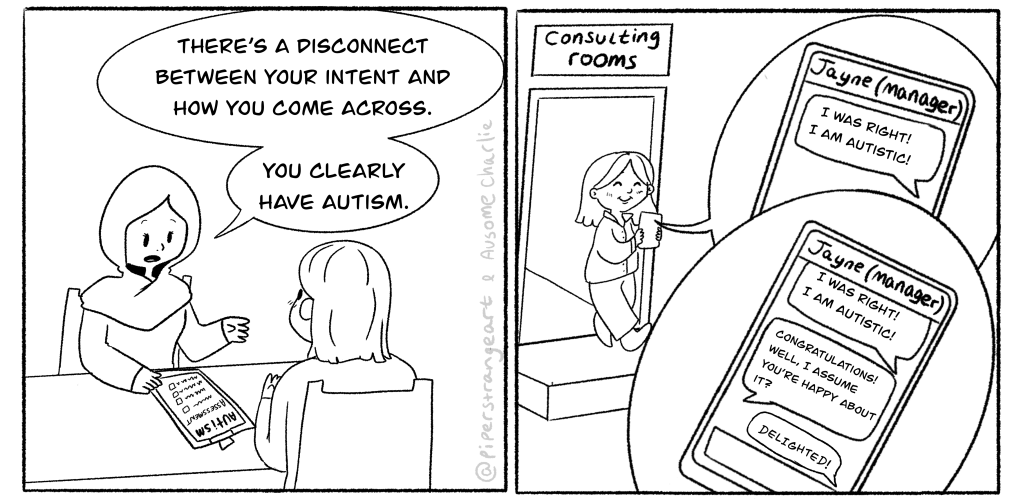
This only rubber-stamped what I already knew, but still, it mattered to me! Identifying my autistic neurotype was extremely validating. My life suddenly started to make so much more sense. I told my line manager straight away, and she congratulated me.
And I learned about the ‘Neurodiversity Paradigm’, a socio-political concept which conveys that each human brain and mind is unique, and this does not mean some are good and some are defective. Neurological diversity, or ‘Neurodiversity’ in a human population is advantageous, like biodiversity is in an ecosystem. We each have unique strengths and challenges, and we all have something to contribute. All kinds of minds matter! And I joined the ‘Neurodiversity Movement’ to promote neurodiversity, aiming for meaningful acceptance and inclusion for neurodivergent people both at work and across society.
No longer did I feel broken or defective. Let down and left to struggle unsupported in the past, yes, but optimistic for the future now, and with so much scope for improving my ability to cope. My self-awareness and self-compassion grew, and I started learning how to identify and advocate for my own needs. This gave me a new spring in my step, and a new sense of purpose!
I started getting a kick out of making a difference to others through my neurodiversity advocacy, both inside and outside of work. Then in June 2023, after 20 years in permanent HR Analyst roles, I left HR to form my own company Ausome Charlie Ltd, as a neurodiversity specialist.
And longer would I be self-conscious about my atypical verbal and non-verbal communication styles. Awkward, me? No, this is all part of my charm. As an authentic neurodivergent keynote speaker, I grant myself permission to take up space, to sparkle and shine, as my authentic self!
My Livid Experience
My autistic epiphany was affirming and positive, yes, but realising that my struggles could have been mitigated far sooner, that could be enraging – particularly when despite the tireless efforts of neurodiversity advocates, the discrimination, misinformation and negative stigma just carries on regardless.
So, here is a little about my ‘livid experience’ of autism. Like ‘lived experience’ but the things I am livid about.
People who preach “be kind”, then bully or mock people for being weird and different.
People who think autistic people are dishonest or shifty, because of our eye contact differences, whether we do not make eye contact because it is uncomfortable, or we make it too intensely or for too long because we have been made to feel self-conscious about it.
People who make us feel self-conscious about eye contact, body language, tone of voice, volume, or any other social communication differences.
Sometimes autistic people know something is a bad idea, and will go horribly wrong, with disastrous consequences, because of our pattern-spotting abilities. Yet nobody listens, and they think you’re “negative” or a harbinger of doom. I relate strongly to Bruno in Encanto, as I know when something terrible is going down, and people need to presume competence and listen to me!
(I am actually very good at worrying, as very few of the things I worry about actually happen)
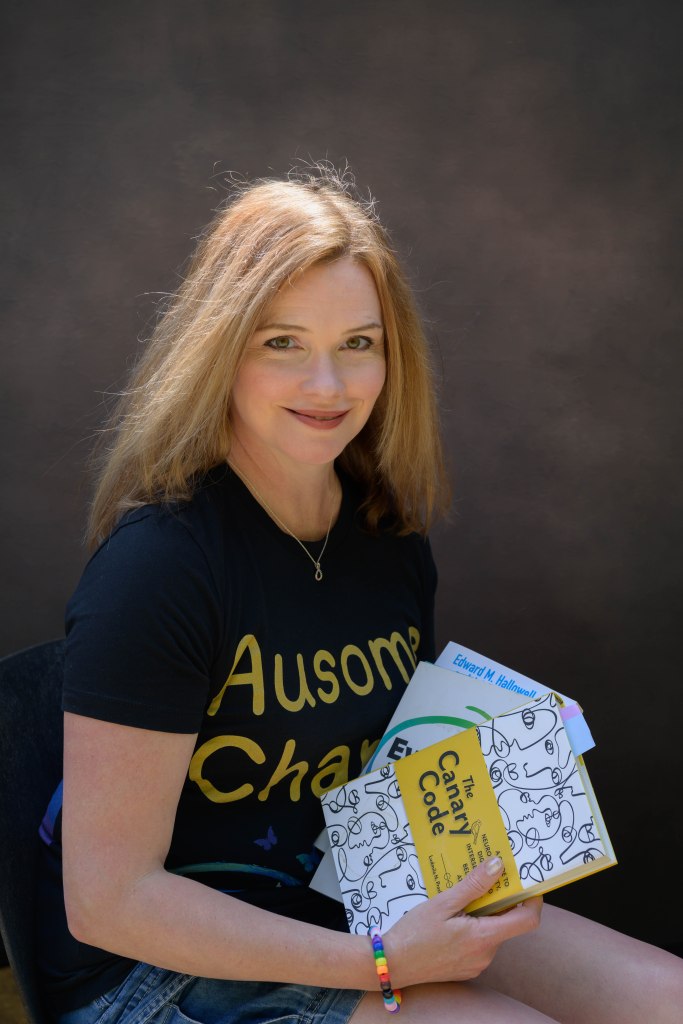
And the canary in the coal mine, picking up on the toxic atmosphere before the other workers, but often being sacrificed. Check out ‘The Canary Code by Ludmila Praslova’ (and chapter 9 features my story of being coaching on interpersonal skills at work before I knew I was autistic).
“How can you be autistic? My nephew is autistic, and you are nothing like him”
Parent-shaming! That old “refrigerator parent” crap, i.e., your child is autistic because you did this/ didn’t do that/ had a stressful pregnancy/ birth… All that crap can get in the bin!
When somebody who is not autistic tells me I should not self-identify as autistic, that I should say “I have autism”. Just, oi, able-splainer, no! You do not get to tell me how to identify!
People who say they accept us, then shame us about how we live, especially AuDHDers (Autistic ADHD) who often live in disarray and cannot keep on top of housework. To accept us is to accept our executive dysfunction, our abandoned creative projects. If you cannot accept us at our messiest, you do not deserve us at our awesomest!
And don’t even get me started on ANTI-VAXXERS!
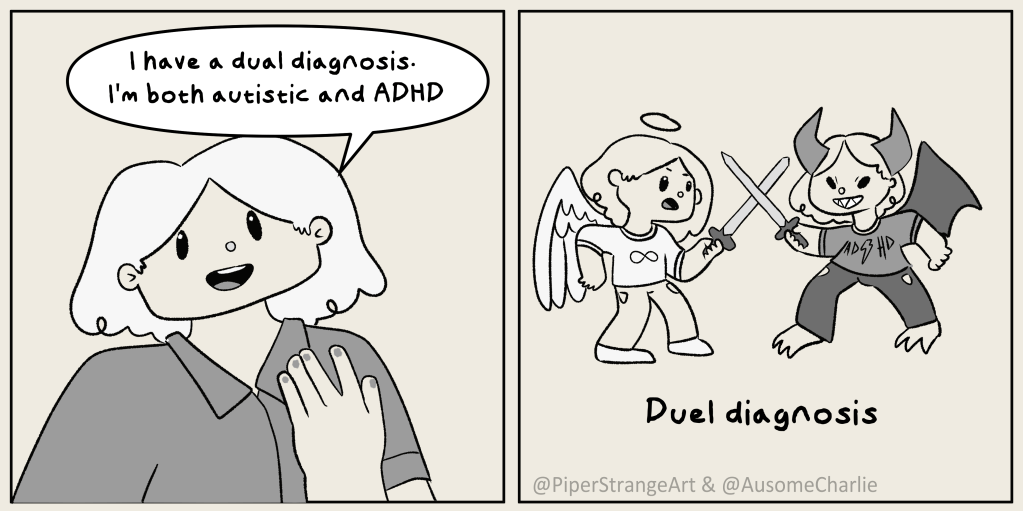
MOST autistic people appear to have ADHD as well, so why not screen for and diagnose both at the same time, which would save us a lot of time and energy and would be logical thing to do!
Finally, bollocks to ‘Autism Awareness’. Understanding us, listening to us, and signal-boosting us is much helpful! Please do not copy and paste blue hearts or puzzle pieces this Autism Acceptance Month – instead, learn from the ‘actually autistic’ community instead! Look for #ActuallyAutistic on social media.
And to my autistic neurokin, happy Autism Acceptance Month, and stay ausome!
 Ausome Charlie
That “duel diagnosis” art feels too real as an AuDHD person. Sometimes it does feel like autism is the angel telling me to stick to my routines and do self-care, while ADHD says it’s time to play mobile games way past my bedtime!
LikeLike